There are four kinds of sage and they behave differently
"Sage" covers a wide band. What separates them is the base underneath the green, and that base is what decides whether the room works in your light.
1. Grey-based sage
Quiet, and the riskiest
The most popular family and the one most likely to disappoint. In a bright south-facing room it is beautiful. In a north-facing room it turns to plain grey.
- Palest #DFE3DC
- Light #BEC7BB
- Mid #9AA69A
- Trim #F8F6F0
- Contrast #414A40
2. Yellow-based sage
Warm, forgiving, best for dark rooms
Reads slightly olive on the chip and slightly green on the wall, which is exactly what you want. This is the one to choose if the room faces north.
- Palest #E7E9D9
- Light #C8CDAF
- Mid #A3AC85
- Trim #F9F6EC
- Contrast #4C5340
3. Blue-based sage, sometimes sold as sea or eucalyptus
Cooler, coastal-adjacent
Fine in a bright room, and it makes an excellent pairing with white oak. In artificial light it can drift towards a pale teal.
- Palest #E1E9E5
- Light #BACCC4
- Mid #8FA79D
- Trim #F7F7F3
- Contrast #3D4E49
4. Deep sage, edging into olive
For a room you want dark
Full-strength on the walls with cream trim and two lamps. Reads expensive and it is one gallon of paint.
- Trim #F4F1E7
- Olive sage #77835F
- Deep #5C6A4E
- Brass #C9A227
- Shadow #2C3428
Widely used examples across the four families include Sherwin-Williams Evergreen Fog and Sea Salt, and Benjamin Moore October Mist and Quiet Moments. Take the one that looks slightly too green on the chip. It will not be, on the wall.
What goes with sage
| Element | Best | Works | Avoid |
|---|---|---|---|
| Trim and ceiling | Warm white or cream | The wall color at 50 percent | Bright builder white, which makes sage look dirty |
| Wood | Warm mid oak, rattan | White oak, birch | Orange pine, grey-washed wood |
| Metal | Unlacquered brass, matte black | Bronze | Chrome and brushed nickel, which go cold next to green |
| Accent color | Clay, blush, mustard | Cream, camel | Cool grey, lavender, bright yellow |
| Textiles | Linen, boucle, jute | Cotton in cream | Anything shiny or synthetic in a competing green |
The single highest-leverage line in that table is the trim. Sage walls with a warm white trim is a finished room. Sage walls with the bright white the builder used is the most common reason a sage nursery looks off and nobody can say why.
One room, start to finish
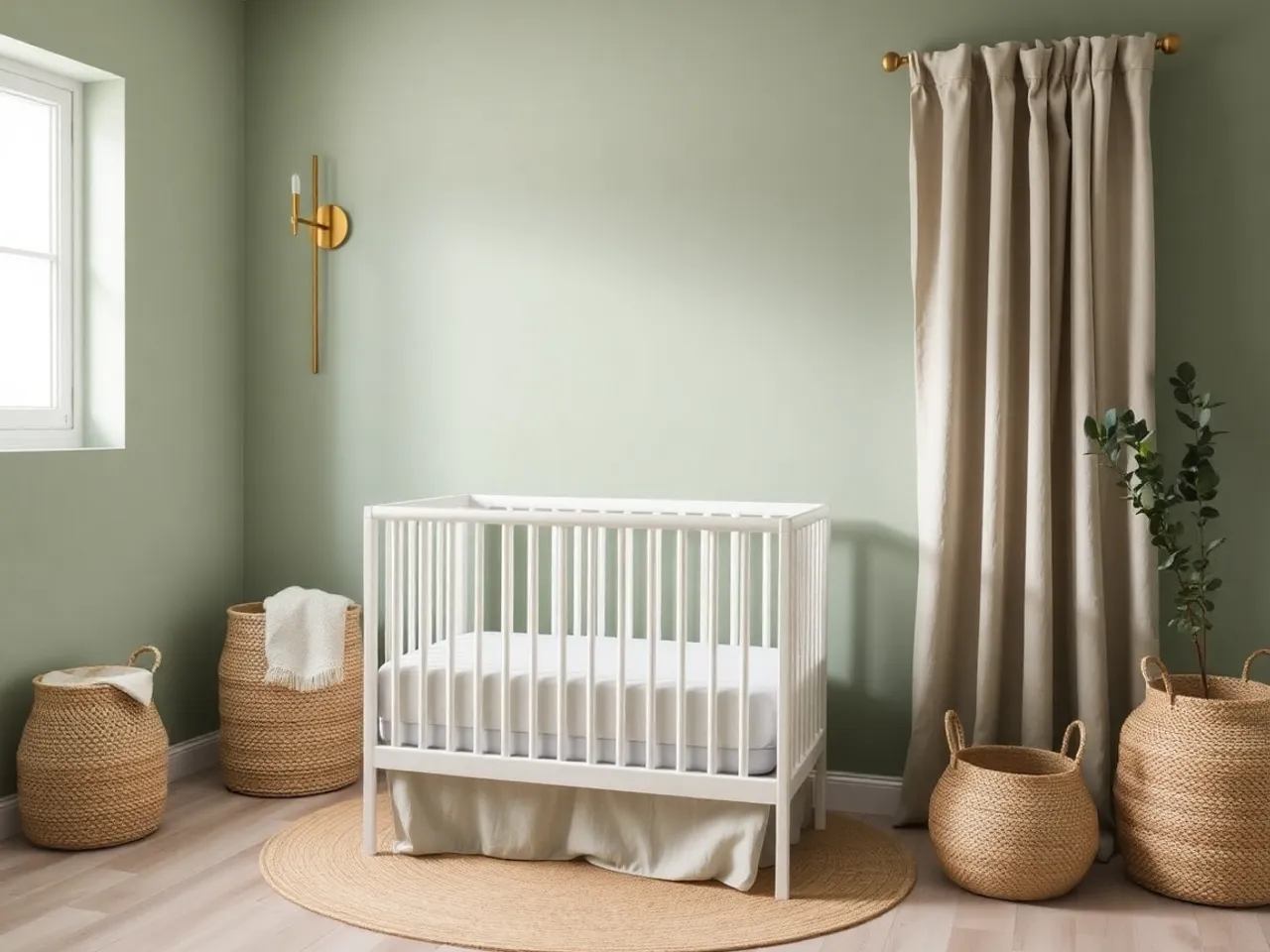
- Walls: mid sage, eggshell, all four walls. No accent wall.
- Ceiling: the wall color at 25 percent, flat finish.
- Trim: warm white, satin.
- Crib: white or warm oak. Both work. White gives more contrast, oak gives more warmth.
- Dresser: the opposite of the crib, so the room has two tones rather than one.
- Rug: jute or a cream low-pile wool blend, 8 by 10 if the room takes it.
- Curtains: oatmeal linen, hung 6 inches above the frame and 8 inches wide of it, with a separate blackout blind inside the recess.
- Lighting: a woven or fabric pendant plus one brass sconce or lamp by the chair, both at 2700K.
- Accent: one clay or blush textile and one matte black element. That is the whole scheme.
When sage goes wrong
- It reads grey. Grey-based sage plus north light plus cool bulbs. Change the bulbs to 2700K first. If it is still grey, repaint one shade greener.
- It reads minty. The green is too clean and too light. Sage should look slightly dirty. Clean greens read as a bathroom.
- It looks unfinished. Almost always the trim. Warm white trim, not bright white.
- It looks flat. No dark element anywhere in the room. Add black hardware, a dark frame or a bronze curtain rod.
- It fights the floor. Orange-toned wood floors and cool sage do not get along. Move to the yellow-based sage family.
Questions people actually ask
What colors go with sage green in a nursery? +
Is sage green too dark for a small nursery? +
Does sage work for a boy or a girl? +
Why does my sage look grey? +
Keep going
All nursery paint colors
The other families, undertone traps and how to test.
Woodland nursery
The same green with a theme on top.
Gender neutral nursery
Why sage became the default neutral.
Baby boy nursery ideas
Sage in a boy room, and what replaced grey.
Baby girl nursery ideas
Sage with blush, which is the longest-lasting girl palette.
Nursery layout planner
Where the crib goes, before any of this matters.